
How Long Do Different Retaining Wall Materials Last in Queensland’s Climate?
Building a structural barrier on a sloped Queensland property is never just a simple landscaping decision—it is a long-term engineering investment. From the tropical downpours of the Far North to the subtropical humidity, blazing UV rays, and reactive clay soils of South East Queensland, our local weather tests outdoor structures to their absolute limits. If you are planning an earth-retention project, the central question you must ask is: How Long Do Different Retaining Wall Materials Last in Queensland’s Climate?
Selecting the right retaining walls materials means balancing initial installation expenditure against total lifecycle cost, structural safety, and maintenance requirements. A timber wall might look cost-effective initially, but torrential summer monsoons and subterranean termite pressure can drastically alter the equation. In this comprehensive guide, we unpack the performance, durability, environmental challenges, and expected lifespans of popular building products so you can make an informed decision for your home or development.
The Queensland Factor: Environmental Pressures on Structural Walls
To understand How Long Do Different Retaining Wall Materials Last in Queensland’s Climate?, one must first understand the aggressive natural elements at work across the Sunshine State. Structural landscape barriers here do not fail merely from age; they deteriorate due to unyielding environmental stresses.
       QUEENSLAND CLIMATE STRESSORS ON RETAINING WALLS
 ─────────────────────────────────────────────────────────────
  🌧️ Subtropical Rain & Hydrostatic Pressure
     └─ Severe saturation behind walls; improper drainage causes failure
  ☀️ Relentless UV Radiation & Heat Expansion
     └─ Thermal expansion/contraction weakens seals and surface coatings
  🐜 Subterranean Termites & Fungal Decay
     └─ Humid warmth accelerates rot and pest activity in organic materials
  🌱 Highly Reactive Clay Soils (Black Soil Plains)
     └─ Massive swell/shrink cycles exert lateral pressure on foundations
1. Intense Subtropical Rain and Hydrostatic Surcharge
Queensland experiences dramatic rainfall events, particularly during the humid summer wet season. When soil behind an earth barrier becomes waterlogged, the horizontal hydrostatic pressure spikes dramatically. If the retaining walls materials lack integrated subsoil drainage systems, aggregate backfill, and geotextile filtration, the structure can bulge, rotate, or experience catastrophic blowout regardless of material quality.
2. High Ambient Humidity and Fungal Acceleration
Continuous moisture coupled with high heat creates the ideal microclimate for wet rot, dry rot, and wood-decaying fungal spores (basidiomycetes). Organic components in timber-based retaining walls materials break down far more rapidly in Brisbane, the Sunshine Coast, or Cairns than they do in southern capitals like Melbourne or Hobart.
3. Voracious Termite Activity
Queensland boasts some of Australia’s most destructive subterranean termite species, notably Coptotermes acinaciformis. While chemical preservation shields structural timbers temporarily, timber retaining walls materials buried directly in damp soil face relentless exploration by pest colonies.
4. Highly Reactive Soils
From the Lockyer Valley to coastal plains, much of Queensland features expansive clay soil profiles classified as Class M, H, or E under Australian Standard AS 2870. These soils swell significantly when wet and shrink into hard, cracked expanses when dry. This continuous lateral ground movement places tremendous shifting loads upon wall footings, demanding reinforced retaining walls materials capable of withstanding shifting structural tolerances.
When embarking on ground stabilisation, engaging an experienced structural landscaping contractor like APTBuildGroup ensures that local soil classification, load ratings, and council requirements are integrated directly into your engineering design.
Material Breakdown: Comparing Durability, Lifespan, and Suitability
Every material brings distinct strengths and trade-offs to residential and civil projects. Let us examine how the predominant retaining walls materials stack up in durability under Queensland conditions.
┌────────────────────────────────────────┬─────────────────────┬──────────────────┐
│ Retaining Wall Material               │ Expected Lifespan   │ Maintenance Need │
├────────────────────────────────────────┼─────────────────────┼──────────────────┤
│ Treated Pine (H4 Ground Contact)       │ 10 – 15 Years       │ Moderate–High    │
│ Hardwood Sleepers (Class 1 / Treated)  │ 15 – 25 Years       │ Moderate         │
│ Concrete Sleepers (Steel Reinforced)   │ 50 – 80+ Years      │ Very Low         │
│ Interlocking Concrete Masonry Blocks   │ 50 – 100+ Years     │ Very Low         │
│ Poured In-Situ Reinforced Concrete     │ 75 – 100+ Years     │ Low              │
│ Gabion Baskets (Galvanised / PVC Coated│ 40 – 70 Years       │ Negligible       │
│ Natural Stone / Sandstone Pitching     │ 60 – 100+ Years     │ Low              │
└────────────────────────────────────────┴─────────────────────┴──────────────────┘
1. Timber Retaining Walls (Treated Pine & Hardwood)
Expected Lifespan in Queensland: 10 to 20 Years
Timber remains one of the most accessible and budget-friendly retaining walls materials across Australian suburbs. Its natural organic aesthetic blends smoothly with native bush settings and backyard gardens. However, its longevity is notably lower under Queensland conditions compared to any other structural alternative.
       TIMBER SLEEPER WALL ANATOMY
  ══════════════════════════════════════════
  [ Soil Backfill ]
        │  [ Geotextile Fabric Filter ]
        │  [ 20mm Blue Metal Aggregate ]
        ▼         │
  [H4 Treated Pine / Class 1 Hardwood] ◄── Subject to moisture & termites
  ──────────────────────────────────────
  [ Perforated Ag Pipe (Drainage) ] ──► Relieves hydrostatic head
  [ Concrete Bored Pier Footing ]
Performance Factors:
- Preservative Treatment Levels: For timber in ground contact, the chemical treatment level must adhere strictly to Hazard Class 4 (H4) or Hazard Class 5 (H5) under AS 1604. Using under-treated timber (such as H3 framing timber) in direct ground burial in Queensland often leads to failure within 3 to 5 years.
- Treated Pine: Typically sourced from plantation radiata or slash pine, treated pine relies entirely on copper quaternary or CCA treatments to resist fungal decomposition. In damp Queensland environments, rot often establishes around end-cuts, bolt drillings, and unseen contact points between sleepers.
- Hardwood Sleepers: Species such as Ironbark, Spotted Gum, or Grey Box provide natural Class 1 durability. While naturally resistant to borers and fungi, unseasoned hardwood sleepers are prone to surface checking, warping, and shrinkage under extreme Queensland sun exposure.
Maintenance Requirements:
To extract a 15-year service life from timber retaining walls materials, property owners must maintain clear weep holes, inspect for subterranean termite trails annually, seal raw saw cuts with copper-naphthenate based preservatives, and refresh UV-protective oil coatings periodically.
2. Concrete Sleeper Retaining Walls
Expected Lifespan in Queensland: 50 to 80+ Years
When property owners consult engineering specialists on How Long Do Different Retaining Wall Materials Last in Queensland’s Climate?, concrete sleepers consistently rank as one of the best value-to-longevity solutions. Engineered with internal high-tensile steel reinforcement bars, concrete sleepers combine the slim installation footprint of a post-and-sleeper system with the permanence of structural concrete.
   CONCRETE SLEEPER SYSTEM SCHEMATIC
  ┌──────────────┐
  │ Steel H-Post │◄── Galvanised 100UC/150UC Section
  │   (Upright)  │
  ├──────────────┤ ┌────────────────────────────────────┐
  │   Concrete   │ │ Internal 2x N12 Rebar Reinforcement│
  │   Sleeper    │ │ 40-50 MPa High-Density Concrete    │
  ├──────────────┤ └────────────────────────────────────┘
  │   Concrete   │
  │   Sleeper    │
  └──────────────┘
         │
  [ Deep Bored Pier with 25-32 MPa Concrete Mass ]
Performance Factors:
- Impervious to Biological Decay: Unlike timber, concrete sleepers are completely immune to subterranean termite infestations and fungal decay. Termites cannot chew through them, and high atmospheric humidity will not rot them.
- Steel Upright Durability: Concrete sleeper walls rely on heavy steel structural columns (typically 100UC or 150UC universal column sections) embedded in deep, concrete-bored piers. In Queensland’s coastal strips, these steel posts must be hot-dip galvanised to AS/NZS 4680 specifications to prevent saline oxidation.
- Concrete Density and Cover: Premium concrete sleepers are produced using high-strength mixes ($40\text{–}50\text{ MPa}$) with low water-cement ratios. This prevents water penetration from reaching the internal steel reinforcement bars, eliminating the risk of concrete cancer (spalling).
Partnering with licensed structural specialists like APTBuildGroup guarantees that post hole depths, universal column sizing, and sleeper thicknesses comply with both municipal boundary guidelines and local soil wind/surcharge loadings.
3. Segmental Interlocking Concrete Blocks
Expected Lifespan in Queensland: 50 to 100+ Years
Segmental retaining walls (SRWs) constructed from dry-stacked, engineered masonry blocks (such as Boral Keystone, Austral Heron, or Adbri Masonry units) represent another premier choice among heavy-duty retaining walls materials.
      SEGMENTAL GRAVITY / GEOGRID SYSTEM
                  Backfill Zone
  Block Face       (Compacted)
  ┌──┐                 ▲
  │  │◄─ Interlocking  │
  ├──┤   Shear Pin     │   ┌─────────────────────┐
  │  │                 ├───┤ Polyester Geogrid   │
  ├──┤                 │   │ Reinforcement Sheet │
  │  │                 ├───┴─────────────────────┘
  ├──┤                 │
  └──┴─────────────────┴──────────────────────────
  [ Compacted Crushed Rock / Road Base Foundation ]
Performance Factors:
- Dry-Stacked Flexibility: Because segmental blocks interlock mechanically via rear lips, pins, or keys without wet mortar joints, the wall possesses slight inherent flexibility. It can adjust gracefully to the minor ground heave and settlement typical of Queensland’s reactive clay formations without cracking.
- Built-in Drainage Efficiency: The hollow cores of these blocks are filled with clean, crushed drainage aggregate ($10\text{–}20\text{ mm}$ blue metal). Combined with a gravel drainage trench immediately behind the wall, this system rapidly dissipates hydrostatic pressures during sudden summer storms.
- Geogrid Integration for Height: For installations exceeding 1 metre in height, structural geogrid fabric is laid horizontally between block courses deep into the retained embankment. This locks the embankment and block system into a singular, cohesive soil-mass structure capable of lasting over a century.
4. Poured-in-Place Reinforced Concrete Walls
Expected Lifespan in Queensland: 75 to 100+ Years
For high-density residential subdivisions, commercial properties, and steep civil cuttings, cast-in-place concrete stands out as the benchmark of heavy civil engineering among retaining walls materials.
    CANTILEVERED REINFORCED CONCRETE STEM WALL
               │  ◄─ Vertical Stem Wall (200-300mm thick)
               │     Double-layer N-grade rebar cages
               │
               │
  ─────────────┴─────────────── Ground Line
  ┌───────────────────────────┐
  │  Cantilever Concrete Base │ ◄─ Wide footing prevents overturning
  └───────────────────────────┘
Performance Factors: (Retaining Wall Materials)
- Monolithic Structural Integrity: Because the footing and vertical stem are tied together with heavy steel reinforcement and poured as a solid unit (or keyway joined), there are no joint seams through which wet soil can migrate.
- Resilience to Hydraulic Surges: Poured walls handle massive surcharge forces from vehicle driveways, swimming pool installations, and upper terrace structures with minimal deflection.
- Surface Protection in Tropical Climates: In coastal zones within 1 km of the Pacific Ocean, exposed concrete must maintain an adequate cover depth (minimum $40\text{–}50\text{ mm}$) over steel rebar, often supplemented with silane-based penetrating sealers or epoxy barrier coats to block airborne chlorides from triggering internal corrosion.
5. Gabion Baskets (Wire Mesh Filled with Rock)
Expected Lifespan in Queensland: 40 to 70 Years
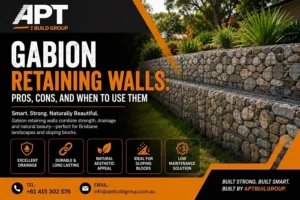
Gabion retaining walls—composed of welded wire or twisted hexagonal woven mesh cages packed with basalt, granite, or river rock—have transitioned from purely civil riverbank reinforcement into high-end architectural and residential landscaping across Queensland.
       GABION ROCK BASKET STRUCTURE
  ┌───────────┬───────────┐
  │  Basalt   │  Granite  │ ◄─ Rock infill: non-degrading, non-porous
  │   Stone   │   Stone   │
  ├───────────┼───────────┤
  │   Heavy   │   Gauge   │ ◄─ Galfan (Zinc-Aluminium) or PVC coated mesh
  │ Wire Mesh │ Wire Mesh │
  └───────────┴───────────┘
  [ 100% Free-Draining Mass: Zero Hydrostatic Pressure ]
Performance Factors:
- Zero Hydrostatic Head Pressure: Gabions are naturally free-draining. Water from tropical storms passes straight through the voids between the hand-placed stones, making hydrostatic wall failure virtually impossible.
- Mesh Wire Metallurgy: The lifespan of gabions depends entirely on the wire protection. Standard electro-galvanised wire will corrode within 10 to 15 years in coastal Queensland humidity. However, Galfan-coated wire (a 95% zinc, 5% aluminium alloy) or UV-stabilised PVC-sheathed mesh resists atmospheric salt spray and acid soils, reliably lasting 50 years or more.
- Dynamic Geotechnical Accommodation: Gabions settle, twist, and articulate without losing overall structural containment, making them particularly valuable over unstable, slip-prone hillside terrains.
6. Natural Stone and Sandstone Boulders (Retaining Wall Materials)
Expected Lifespan in Queensland: 60 to 100+ Years
Sandstone block walls (sawn split-face blocks or unshaped rock pitching) are widely used across South East Queensland developments, particularly around Ipswich, the Lockyer Valley, and northern Gold Coast corridors where quarry supply is abundant.
- Material Durability: Basalt, granite, and dense Helidon sandstone have been compressed over geological epochs; they do not rot, swell, or warp.
- Installation Mechanics: Boulders rely entirely on massive gravitational self-weight. Small rock pitching walls ($<1\text{ metre}$) can be built without mortar, while massive multi-tier boulder walls require excavators equipped with rock grabs to set blocks directly into an engineered cut with a step-back batter angle.
- Vulnerabilities: Softer, highly porous sandstone varieties can show surface spalling or black algal staining in perpetually damp, shaded sub-tropical valleys unless treated with breathable mineral water-repellents.
Critical Factors That Shorten Wall Lifespan in Queensland
When walls lean, crack, or fail prematurely, property owners often blame the manufacturer of the retaining walls materials. Yet structural forensic investigations show that premature failures are almost always caused by poor installation techniques and neglected geotechnical details.
     COMMON SHORTCUTS CAUSING PREMATURE FAILURE
  ┌───────────────────────────────┬────────────────────────────────────────┐
  │ Shortcut / Defect             │ Consequence in Queensland Climate      │
  ├───────────────────────────────┼────────────────────────────────────────┤
  │ Omitting Perforated Ag Pipe   │ Water pools behind wall, causing       │
  │                               │ catastrophic blowout during storms     │
  ├───────────────────────────────┼────────────────────────────────────────┤
  │ Using Native Clay Backfill    │ Clay retains water, expands, and       │
  │                               │ crushes structural wall faces          │
  ├───────────────────────────────┼────────────────────────────────────────┤
  │ Shallow Pier Hole Depth       │ Reactive soil heave levers upright     │
  │                               │ posts out of plumb alignment           │
  ├───────────────────────────────┼────────────────────────────────────────┤
  │ Untreated Saw Cuts on Timber  │ Creates rapid entry point for rot      │
  │                               │ and subterranean termites              │
  └───────────────────────────────┴────────────────────────────────────────┘
Neglecting Backfill Permeability
Backfilling directly against any retaining wall with native reactive clay is a recipe for failure. Clay absorbs moisture, expands exponentially, and blocks drainage paths. The zone immediately behind the wall ($300\text{ mm}$
minimum width) must always consist of free-draining $10\text{–}20\text{ mm}$
aggregate encased in non-woven geotextile fabric to keep fine silts from choking the system.
Inadequate Footing Depth
In post-and-sleeper wall configurations, the depth of the underground bored pier must typically equal or exceed the height of the retained soil face above ground ($1:1\text{ rule of thumb}$
, subject to specific engineer designs). Shorter footings frequently rotate forward when wet seasons turn Queensland subsoils into soft, plastic foundations.
Council Regulations and Approvals in Queensland
Under the Queensland Development Code and the Planning Act 2016, retaining structures must satisfy strict compliance thresholds before earthworks commence:
        QUEENSLAND COUNCIL BUILDING APPROVAL THRESHOLDS
 ─────────────────────────────────────────────────────────────
  📐 Height Trigger:
     └─ Walls over 1.0m above natural ground require certified engineering
        and formal Council / Private Certifier Building Approval.
  📏 Surcharge / Zone of Influence Trigger:
     └─ Walls of ANY height within 1.5m of a boundary, building footings,
        easements, or driveways require structural engineering certification.
  📋 Standards Compliance:
     └─ AS 4678 (Earth-Retaining Structures)
     └─ AS 3600 (Concrete Structures)
     └─ AS 1726 (Geotechnical Site Investigations)
Attempting uncertified DIY wall construction above one metre carries substantial legal liability, non-compliance fines, and hazards during home resales. Reputable builders like APTBuildGroup oversee all compliance documentation, including soil testing, Form 15 design certificates, and Form 16 inspection milestones signed off by qualified RPEQ (Registered Professional Engineer of Queensland) professionals.
Cost vs. Lifespan: Evaluating Total Return on Investment
When evaluating How Long Do Different Retaining Wall Materials Last in Queensland’s Climate?, it is vital to balance the initial square-metre building costs against the amortised cost per year of functional service life.
       LIFECYCLE COST COMPARISON (PER SQUARE METRE ESTIMATES)
  ┌──────────────────┬──────────────┬──────────────┬─────────────────────┐
  │ Material Type    │ Cost / m²    │ Lifespan     │ Amortised Cost/Year │
  ├──────────────────┼──────────────┼──────────────┼─────────────────────┤
  │ Treated Pine     │ $250 - $400  │ 10-15 Years  │ $25.00 - $30.00     │
  │ Hardwood Sleepers│ $350 - $550  │ 15-20 Years  │ $23.00 - $27.50     │
  │ Concrete Sleeper │ $500 - $850  │ 60-80 Years  │ $8.00 - $11.00      │
  │ Segmental Blocks │ $450 - $800  │ 75-100 Years │ $6.00 - $8.50       │
  │ Sandstone Blocks │ $400 - $750  │ 80-100 Years │ $5.00 - $7.50       │
  └──────────────────┴──────────────┴──────────────┴─────────────────────┘
While treated pine features an appealing upfront installation price, replacing a rotted timber wall every twelve to fifteen years—complete with demolition, excavation, waste dumping fees, and garden remediation—proves far more expensive over a home’s lifetime than installing concrete or stone systems from day one.
Proactive Maintenance Tips for Long-Lasting Walls
Regardless of which retaining walls materials you ultimately choose, regular maintenance will help preserve their engineered lifespan:
- Clear Weep Holes Regularly: Ensure that grass clippings, leaf mulch, and garden topsoil never obstruct the base weep holes or pipe outlets along the front of the wall.
- Inspect Slotted Ag Lines: Following heavy subtropical downpours, verify that the PVC discharge pipes outfall cleanly into the street stormwater channel or drainage pit without silt blockages.
- Control Surcharge Loads: Never park heavy caravans, trucks, or position above-ground swimming pools within the structural zone of influence behind an existing wall unless it was explicitly engineered for surcharge loadings.
- Maintain Termite Barriers: If using hardwood or pine, maintain physical clearance between landscaping timbers and your main residential foundation slab, keeping pest inspection lanes open at all times.
Conclusion: How Long Do Different Retaining Wall Materials Last in Queensland’s Climate?
Selecting retaining walls materials in Queensland requires balancing aesthetic preferences with local weather realities. To summarise expected structural lifespans:
- Treated Pine: 10 to 15 years (vulnerable to rot and termite attack in high-humidity zones).
- Hardwood Timber: 15 to 20 years (dense, but subject to warping and eventual decay).
- Concrete Sleepers: 50 to 80+ years (impermeable to biological attack; highly stable).
- Segmental Masonry Blocks: 50 to 100+ years (excellent drainage integration and movement tolerance).
- Reinforced Poured Concrete: 75 to 100+ years (unmatched structural load resistance).
- Gabions & Natural Rock: 50 to 100 years (exceptional drainage; enduring natural aesthetics).
For homeowners seeking permanent value and zero-maintenance peace of mind, reinforced concrete sleepers, masonry segmental units, and natural rock remain the premier choices.
When you are ready to construct a stable, durable, and fully certified structure across your residential or commercial contours, consult the experienced civil and landscape construction team at APTBuildGroup. With complete knowledge of local soil mechanics, environmental factors, and engineering guidelines, they will help you build a retaining wall designed to endure Queensland’s climate for decades to come.