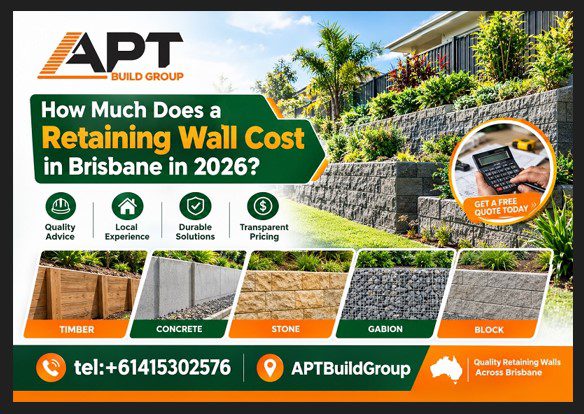
Retaining Wall Cost in Brisbane in 2026?
Planning an outdoor landscape transformation, creating a level turf platform, or stabilising an unstable hillside block across South East Queensland requires precise budgeting. For property owners and property developers alike, the primary question before undertaking major ground alterations is: How Much Does a Retaining Wall Cost in Brisbane in 2026?
Retaining structures in South East Queensland serve critical structural and architectural functions. However, calculating true earthwork and construction expenditure is rarely as simple as multiplying square metres by an arbitrary unit rate. With evolving Australian standards, inflationary adjustments in raw construction materials, rising machine hire expenses, and strict municipal building codes, understanding your anticipated financial layout is vital.
In this thorough guide, we examine the typical price per square metre across all leading materials, investigate hidden excavation and engineering expenses, look into council certification requirements, and explain how to budget accurately for your property.
The Short Answer: Average Retaining Wall Cost in Brisbane in 2026
If you are seeking a high-level pricing benchmark, the typical retaining wall cost in Brisbane in 2026 ranges between $320 and $1,150+ per square metre ($/m^2$) for fully installed systems, incorporating labour, plant machinery, structural materials, and foundational backfill.
       BRISBANE RETAINING WALL PRICE SPECTRUM (2026 INSTALLED RATES)
  ┌──────────────────────────────┬─────────────────────────┬──────────────────────┐
  │ Material Classification      │ Price Range ($/m²)      │ Durability Outlook   │
  ├──────────────────────────────┼─────────────────────────┼──────────────────────┤
  │ Treated Pine Sleepers (H4)   │ $320 – $480 / m²        │ 10 – 15 Years        │
  │ Hardwood Sleepers (Class 1)  │ $420 – $650 / m²        │ 15 – 22 Years        │
  │ Concrete Sleepers (Galv Post)│ $600 – $950 / m²        │ 50 – 80+ Years       │
  │ Segmental Concrete Blocks    │ $550 – $900 / m²        │ 60 – 100+ Years      │
  │ Sawn Sandstone Blocks        │ $480 – $880 / m²        │ 80 – 100+ Years      │
  │ Reinforced Poured Concrete   │ $850 – $1,350+ / m²     │ 80 – 100+ Years      │
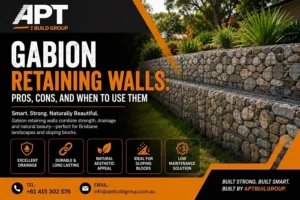
  │ Architectural Gabion Cages   │ $520 – $850 / m²        │ 50 – 70+ Years       │
  └──────────────────────────────┴─────────────────────────┴──────────────────────┘
  *Rates represent standard ground conditions. Complex slopes and limited-access sites will vary.
To achieve an accurate, fully insured, and engineered outcome, working with an established structural contractor like APTBuildGroup ensures transparent itemised pricing without costly surprise variations halfway through excavation.
Detailed Material Breakdown: How Much Does a Retaining Wall Cost in Brisbane in 2026?
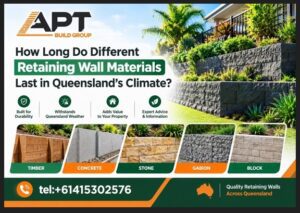
Material selection represents the single largest variable influencing the bottom line of your structural landscaping budget. When determining How Much Does a Retaining Wall Cost in Brisbane in 2026?, you must evaluate initial supply and placement costs against long-term durability in Queensland’s sub-tropical climate.
                  MATERIAL COST & LABOUR DYNAMICS
  ════════════════════════════════════════════════════════════════════
  [ Low Initial Cost / High Upkeep ]        [ Higher Initial / Zero Upkeep ]
  Treated Pine  ──►  Hardwood  ──►  Sandstone  ──►  Concrete  ──►  Poured Concrete
  ($320/m²)         ($450/m²)      ($550/m²)       ($650/m²)      ($1,000+/m²)
1. Treated Pine Timber Sleepers ($320 – $480 per m²)
Treated timber remains the most budget-friendly upfront option. Utilizing plantation radiata or slash pine impregnated with copper quaternary or CCA preservatives to Hazard Level H4 (direct in-ground contact), timber post-and-sleeper walls are popular for low garden terraces and boundary borders.
- Advantages: Lowest initial material cost; fast installation with small earthmoving gear; rustic garden aesthetic.
- Drawbacks in Brisbane: Subtropical humidity and subterranean termites (Coptotermes acinaciformis) will shorten pine lifespans to 10–15 years.
- Typical Project Cost: A 15-metre long, 0.8-metre high timber retaining wall costs roughly $3,840 to $5,760.
2. Hardwood Timber Sleepers ($420 – $650 per m²)
Naturally durable Australian hardwoods (such as Ironbark, Tallowwood, or Spotted Gum) provide higher density and natural structural resistance compared to softwood pine.
- Advantages: High mechanical impact resistance; rich organic appearance.
- Drawbacks: Sleepers are heavy, increasing manual handling labour; prone to surface checking, warping, and tannin leaching in hot summer sun.
- Typical Project Cost: A 20-metre long, 1.0-metre high hardwood installation averages between $8,400 and $13,000.
3. Concrete Sleeper Retaining Systems ($600 – $950 per m²)
Concrete sleeper systems with structural steel posts represent the industry gold standard for boundary stabilization, perimeter walls, and residential developments across South East Queensland. Concrete sleepers are manufactured with internal N12 steel reinforcing bars and 40–50 MPa concrete mixes.
       CONCRETE SLEEPER & STEEL POST DETAIL
       ┌──────────────────────────────┐
       │ Galvanised 100UC / 150UC Post│
       └──────────────┬───────────────┘
                      ▼
   ═══════════════════════════════════════════
   [ 50 MPa Reinforced Concrete Sleeper Units ]
   ═══════════════════════════════════════════
                      ▲
                      │
   [ Deep Bored Piers Filled With 25-32 MPa Concrete Core ]
- Advantages: Rot-proof, termite-proof, fireproof; compact boundary footprint; lifespan exceeding 60 years.
- Drawbacks: Requires medium-to-heavy excavators fitted with augers and sleeper grab attachments.
- Typical Project Cost: A 25-metre long, 1.2-metre high concrete sleeper wall generally ranges between $18,000 and $28,500.
For high-specification boundary walls needing absolute vertical alignment and durability, the licensed construction team at APTBuildGroup provides precision installation backed by complete structural warranties.
4. Segmental Interlocking Masonry Blocks ($550 – $900 per m²)
Dry-stacked engineered concrete block systems (such as Austral Heron, Boral Keystone, or Adbri units) interlock via pins or rear lips without wet mortar beds.
- Advantages: Clean, contemporary visual finish; slight mechanical flexibility to absorb minor ground heave; excellent integrated drainage cavities.
- Drawbacks: Requires a wide, compacted road-base trench footing; heights over 1 metre require structural geogrid fabric laid back into the soil mass.
- Typical Project Cost: A curved 18-metre long, 1.0-metre high block terrace costs between $9,900 and $16,200.
5. Sawn Helidon Sandstone Blocks ($480 – $880 per m²)
With quarries operating locally in the Lockyer Valley, sandstone block walls are widely specified in large estates across Brisbane, Ipswich, and the Gold Coast.
- Advantages: Exceptional natural beauty; massive gravity stability; lifespan of 80 to 100+ years.
- Drawbacks: Requires wide access for 10-to-20 tonne excavators; wide footprint takes up usable yard space.
- Typical Project Cost: A 30-metre long, 1.0-metre high “B-Grade” sawn sandstone wall typically costs $14,400 to $26,400.
Primary Site Variables Affecting Your Project Quote
When prospective builders calculate How Much Does a Retaining Wall Cost in Brisbane in 2026?, the raw material cost is only one component of the equation. Site characteristics significantly influence total expenditure.
           MAJOR COST-DRIVING SITE FACTORS
 ─────────────────────────────────────────────────────────────
  🚜 Site Accessibility:
     └─ Narrow side-paths (<1.2m) necessitate micro-machinery or hand-digging.
  ⛰️ Slope & Fall Dynamics:
     └─ Steep embankments require benched cuts, safety shoring, and complex anchoring.
  🪨 Subsurface Rock Formations:
     └─ Solid Brisbane Tuff or blue rock requires hydraulic rock-breakers.
  💧 Saturated Clay Hydrology:
     └─ Highly reactive Class H/E clay soils demand extensive subsoil drainage pipes.
1. Site Access Limitations
If an excavator cannot access the build zone through a standard side gate, specialized micro-excavators or track-barrows must be deployed. In extreme situations where machinery cannot enter, pier holes must be hand-dug and concrete barrowed manually, increasing the overall retaining wall cost in Brisbane by 25% to 50% in direct labour hours.
2. Subsurface Geology and Rock Encounter
Brisbane’s geology varies widely. Suburbs like Kangaroo Point, Hamilton, and Spring Hill frequently present hard porphyry (Brisbane Tuff), while western and northern regions feature dense clays or granite seams. Encountering hard rock during post-hole augering triggers hourly pneumatic hammer or rock-saw surcharges ($180–$280/hr plant rates).
3. Surcharge Loads and Elevated Slopes
Walls supporting nothing more than a level grass lawn experience minimal active soil pressure. Conversely, if your wall retains an elevated driveway, a swimming pool, or an uphill neighbour’s double-storey brick garage, lateral surcharge loads increase dramatically. This requires deeper bored footings, heavier universal steel columns (UC beams), and reinforced sleeper configurations, shifting your overall retaining wall cost in Brisbane into higher tiers.
When navigating tricky access points or heavily loaded boundary slopes, consulting with APTBuildGroup ensures that site constraints are reviewed thoroughly before heavy equipment lands on site.
Brisbane City Council (BCC) Approvals and Engineering Fees in 2026
Property owners frequently ask: Do I need council approval to build an earth-retaining wall in Brisbane?
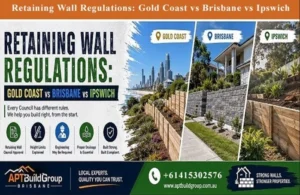
Under the Queensland Planning Scheme, the Queensland Development Code, and Brisbane City Council local planning laws, distinct regulatory thresholds apply:
        QUEENSLAND STATUTORY APPROVAL THRESHOLDS
 ─────────────────────────────────────────────────────────────
  📐 Height Trigger:
     └─ Any structural wall over 1.0 metre above natural ground level
        legally requires formal Building Approval and RPEQ Engineering.
  📏 Boundary & Influence Zones:
     └─ Any wall of ANY height constructed within 1.5 metres of another
        structure footing or property boundary requires certification.
  📋 Engineering Certification Packages:
     └─ Form 15 (Design Certification by RPEQ Engineer)
     └─ Form 16 (Inspection Stage Sign-Off by Engineer/Certifier)
       TYPICAL APPROVAL & ENGINEERING COST BREAKDOWN (2026)
  ┌──────────────────────────────────────────────┬──────────────────┐
  │ Professional Service Item                    │ Average Cost AUD │
  ├──────────────────────────────────────────────┼──────────────────┤
  │ Geotechnical Soil Borehole Test (AS 1726)    │ $750 – $1,200    │
  │ Structural RPEQ Engineering Design (Form 15) │ $1,100 – $2,200  │
  │ Private Building Certifier & Lodgement Fees  │ $1,200 – $1,800  │
  │ Final Structural Inspection & Form 16        │ $550 – $950      │
  └──────────────────────────────────────────────┴──────────────────┘
Failing to secure proper certification can halt construction, lead to municipal enforcement notices, and create legal complications when selling your property. When you choose a full-service commercial and residential contractor such as APTBuildGroup, the complete engineering design, soil testing, and private building certification process is managed directly on your behalf.
Crucial Structural Details: Backfill, Geofabric, and Drainage Systems
A common question among homeowners is: How Much Does a Retaining Wall Cost in Brisbane in 2026? The reality is that the longevity of any wall depends largely on the components hidden behind it.
Queensland’s wet season brings severe, concentrated rainfall that rapidly saturates backfilled soil. Saturated earth exerts hydrostatic pressure that far exceeds dry soil weight:$$\text{Total Lateral Pressure} = P_{\text{soil}} + P_{\text{hydrostatic}}$$
If trapped water cannot escape rapidly, the wall will crack, rotate, or blow out completely.
       CROSS-SECTION OF A CORRECTLY ENGINEERED DRAINAGE SYSTEM
  ─────────────────────────────────────────────────────────────
     │  Natural Ground Backfill
     │  ┌────────────────────────────────────────────────────┐
     │  │ Non-Woven Geotextile Filter Fabric (Bidim A14)     │
     │  │ ┌────────────────────────────────────────────────┐ │
     │  │ │ Clean 20mm Blue Metal Drainage Aggregate       │ │
     │  │ │                                                │ │
     │  │ │     ┌────────────────────────────┐             │ │
     │  │ │     │ 100mm Slotted Ag Pipe      │             │ │
     │  │ │     │ (Wrapped in Geofabric Sock)│             │ │
     │  │ │     └─────────────┬──────────────┘             │ │
  ───┴──┴─┴───────────────────┼────────────────────────────┴─┴─
                              ▼
        [ Connected Directly to Legal Stormwater Point of Discharge ]
Essential Drainage Elements:
- Slotted Corrugated Ag Pipe: A 100mm slotted PVC or flexible agricultural pipe laid at the base of the footing, pitched to clear discharge points.
- Clean Drainage Gravel: A 300mm minimum chimney of 20mm crushed blue metal gravel to channel water downward freely.
- Geotextile Membrane Fabric: Class-A non-woven filtration fleece separating the native clay soil from the drainage aggregate, preventing silt from clogging the drainage bed.
Skimping on subsoil aggregate or agricultural drainage might save a few hundred dollars upfront, but it represents the most common cause of early wall failure. This leads to costly repairs that dwarf initial installation expenses.
Step-by-Step Scenario Pricing: How Much Does a Retaining Wall Cost in Brisbane in 2026?
To help you visualise real-world budgets, let us review three standard residential scenarios in Brisbane.
  SCENARIO 1: Front Yard Garden Tiering (Treated Pine)
  ─────────────────────────────────────────────────────────────
  • Length: 12 metres | Height: 0.6 metres (7.2 m²)
  • Excavation: Minor bobcat scrape
  • Engineering: Not required (< 1.0m, outside boundary zone)
  • Retaining Wall Cost in Brisbane: Approx. $2,450 – $3,200

  SCENARIO 2: Boundary Line Retaining (Concrete Sleeper System)
  ─────────────────────────────────────────────────────────────
  • Length: 22 metres | Height: 1.2 metres (26.4 m²)
  • Excavation: Medium excavator, 450mm augered post holes in clay
  • Engineering: RPEQ Form 15/16 + Private Certifier Approval
  • Retaining Wall Cost in Brisbane: Approx. $18,500 – $24,800

  SCENARIO 3: Major Hillside Cut & Swimming Pool Bench (Masonry Block)
  ─────────────────────────────────────────────────────────────
  • Length: 35 metres | Height: 1.8 metres (63.0 m²)
  • Excavation: 14-tonne excavator, rock breaking, spoil removal
  • Engineering: Deep core-filled block, geogrid sheets, RPEQ design
  • Retaining Wall Cost in Brisbane: Approx. $48,000 – $68,000+
As demonstrated above, wall height, boundary proximity, and soil conditions cause the overall retaining wall cost in Brisbane to scale quickly from minor landscaping work into major structural engineering projects.
Long-Term Investment: Initial Build Costs vs. Lifespan Replacement
Homeowners comparing quotes must weigh the immediate out-of-pocket figure against the total cost of ownership across decades.
       30-YEAR TOTAL COST OF OWNERSHIP COMPARISON
  ┌─────────────────────────────┬───────────────────┬───────────────────┐
  │ Expense Phase               │ Treated Pine Wall │ Concrete Sleepers │
  ├─────────────────────────────┼───────────────────┼───────────────────┤
  │ Initial Construction (Year 1)│ $4,500            │ $8,800            │
  │ Maintenance & Re-sealing    │ $1,200            │ $0                │
  │ Total Demolition & Rebuild  │ $8,200 (Year 14)  │ $0                │
  │ Secondary Rebuild Cycle     │ $11,500 (Year 28) │ $0                │
  ├─────────────────────────────┼───────────────────┼───────────────────┤
  │ Cumulative 30-Year Outlay   │ $25,400           │ $8,800            │
  └─────────────────────────────┴───────────────────┴───────────────────┘
While timber offers an affordable starting figure, choosing concrete or interlocking block systems delivers structural stability for generations. That permanence makes them an excellent choice for preserving long-term property equity.
Experienced civil builders like APTBuildGroup guide clients through cost-benefit trade-offs, helping you select materials tailored to your architecture, site requirements, and budget.
Essential Questions to Ask Before Hiring a Builder
Before accepting a quote or signing a contract for an earth-retaining structure, ask your contractor these key questions to protect your investment:
- Are you fully licensed with the QBCC? Confirm the contractor holds a valid Queensland Building and Construction Commission licence in structural landscaping or builder general classifications.
- Does the proposal include certified structural engineering? If the wall exceeds 1 metre in height or is near a boundary, confirm that Form 15 and Form 16 sign-offs are covered in the quote.
- What specific drainage system is included? Verify the diameter of the agricultural line, the type of backfill aggregate, and the geotextile fabric specifications.
- Are site disposal fees included? Excavating footings generates significant soil and rock spoil. Ensure waste disposal, dumping fees, and transport are explicitly detailed.
- What warranties cover materials and workmanship? Confirm the structural guarantee periods on steel uprights, concrete components, and structural settlement.
Cost-Saving Strategies That Protect Structural Integrity
While structural shortcuts create serious safety hazards, there are practical steps you can take to manage your overall retaining wall cost in Brisbane:
           SMART BUDGET-OPTIMIZATION TACTICS
  ┌────────────────────────────────────────────────────────────────────────┐
  │ 1. Combine Excavation Projects                                         │
  │    Coordinate your retaining wall work with driveway, pool, or lawn    │
  │    leveling to reduce plant machinery delivery and float charges.      │
  ├────────────────────────────────────────────────────────────────────────┤
  │ 2. Use Stepped or Terraced Profiles                                   │
  │    Splitting a single 1.8m wall into two 0.9m stepped tiers can reduce │
  │    earth pressure, potentially avoiding complex engineering tiers.     │
  ├────────────────────────────────────────────────────────────────────────┤
  │ 3. Clear Site Access Ahead of Time                                     │
  │    Temporarily taking down fence panels or trimming low branches lets  │
  │    excavators move freely, avoiding manual handling labour fees.       │
  ├────────────────────────────────────────────────────────────────────────┤
  │ 4. Build Outside Peak Wet Periods                                      │
  │    Scheduling earthworks outside heavy summer rains avoids washouts,   │
  │    water pumping costs, and wet weather site delays.                   │
  └────────────────────────────────────────────────────────────────────────┘
Using these practical strategies keeps your project on budget while ensuring the final structure complies fully with local building codes.
Summary: How Much Does a Retaining Wall Cost in Brisbane in 2026?
To recap: How Much Does a Retaining Wall Cost in Brisbane in 2026?
Expect an entry-level starting point of $320 to $480 per square metre for basic treated pine, increasing to $600 to $950 per square metre for high-strength concrete sleeper systems, and up to $850 to $1,350+ per square metre for heavy-duty cast-in-place reinforced concrete. Project complexities—such as steep slopes, limited equipment access, subterranean rock, and engineering approvals—play an equally important role in determining the final quote.
Investing in a well-built retaining wall secures your land, stops soil erosion, and expands the usable outdoor space of your property.
When you are ready to start planning your site work, turn to the experienced team at APTBuildGroup. With complete knowledge of Brisbane’s soil conditions, engineering standards, and modern earth-retention methods, they deliver reliable, compliant retaining wall installations tailored to your property. Contact APTBuildGroup today to schedule your on-site assessment and receive a detailed, itemised quotation.