Quick answer: If your retaining wall is leaning, bulging, cracking or has water pooling behind it after heavy rain, the most likely cause is trapped water pressure from blocked or missing drainage. Keep people, pets and vehicles away from the wall, photograph everything, and get it assessed before the next storm. Small issues can often be repaired; a wall that is rotating, sliding or failing at the posts usually needs replacing.
The severe storm that hit south-east Queensland on 12 November 2026 was a reminder of how quickly the wet season arrives. It brought more than 120,000 lightning strikes and cut power to nearly 80,000 Brisbane homes and businesses (InDaily). Since then, our phones have been busy with one question: “Is my retaining wall okay?”
We have been building and replacing retaining walls across Brisbane, Logan and the Redlands for more than 15 years. This guide shares exactly what we look for on site, so you can check your own wall today.
Why storms are so hard on retaining walls
A retaining wall rarely fails because of wind. It fails because of water. When heavy rain soaks the soil behind a wall, that soil gets heavier and the water itself pushes against the wall (engineers call this hydrostatic pressure). A wall that copes easily in dry weather can be overloaded within a few hours of a downpour.
That is why drainage matters so much. Most retaining walls need a subsoil drainage system behind the wall to relieve water pressure, and some also need a surface drain at the top or base (Fraser Coast Regional Council). Brisbane’s hilly suburbs, such as Paddington, Camp Hill and Ashgrove, commonly see wall failures during sustained rainfall.
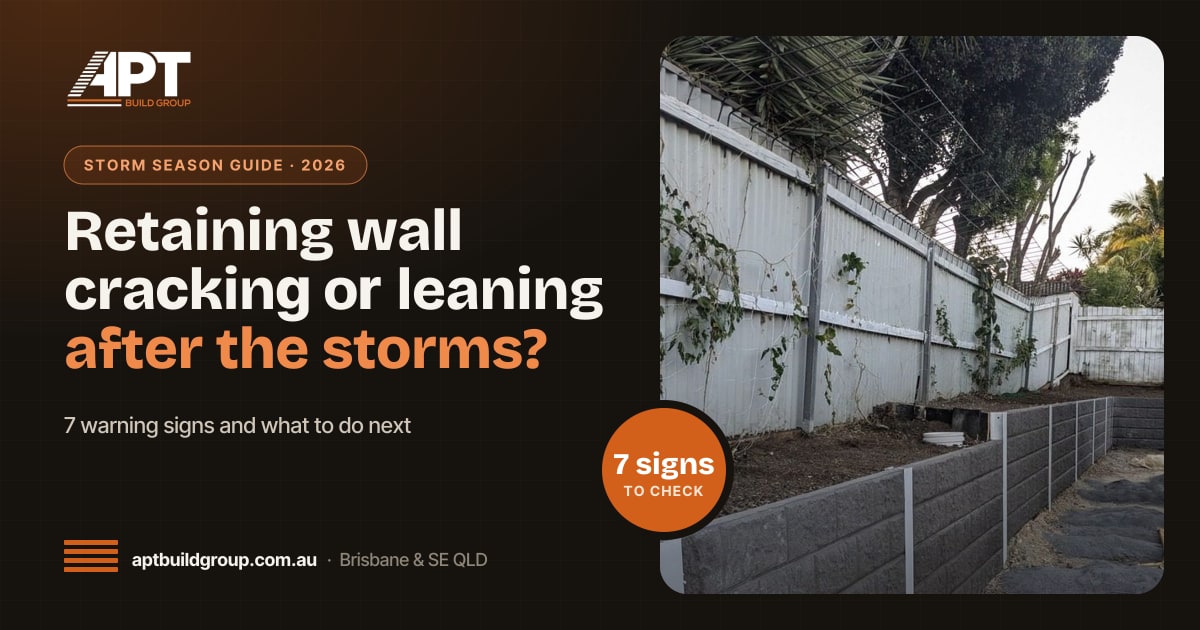
7 warning signs your retaining wall is in trouble
1. The wall is leaning or rotating forward
Stand at one end and look along the top of the wall. It should be straight and close to vertical. A forward lean, or a top that has “rolled” out further than the base, means the wall is losing the battle against the soil behind it. This is the most serious sign on this list.
2. Bulging or bowing in the middle
A belly in the face of the wall, especially halfway between posts, shows the sleepers or blocks are being pushed beyond their strength. On timber walls this often comes just before a sleeper snaps.
3. Cracks in sleepers, blocks or the capping
Hairline cracks in concrete sleepers are not always structural, but stepped cracks in blockwork, cracks that widen after rain, or cracks at the base of steel posts should be checked by a professional.
4. Water pooling or seeping through the wall
Water sitting at the base of the wall, constant wet patches on the face, or muddy water running through joints tell you the drainage is blocked, undersized or missing altogether.
5. Soil washing out at the base or through gaps
If you see a fan of soil or gravel on the low side after rain, the wall is losing its backfill. That leaves voids behind the wall, which can lead to sudden collapse.
6. Cracks or sinking in the ground above the wall
Gaps opening up between the top of the wall and the lawn, or a slumping garden bed above it, suggest the wall is moving. Watch for paths, pool surrounds or slabs near the wall that have dropped or cracked.
7. Rotting timber or rusting posts
Older timber sleeper walls are the most vulnerable. Push a screwdriver into the bottom sleeper: if it sinks in easily, the timber is rotting. On steel-post walls, heavy rust or loss of section at ground level is a red flag. Our guide to how long different retaining wall materials last in Queensland explains why.
What to do in the first 48 hours
- Keep everyone clear. Keep children, pets, cars and caravans away from both the top and bottom of the wall. Don’t stack anything against it.
- Photograph and measure. Take photos from the same spots each day. Put a stake or chalk mark at the top of the wall so you can see if it keeps moving.
- Divert surface water. Redirect downpipes, hoses and pool overflow away from the area behind the wall.
- Don’t dig or backfill yourself. Removing soil from the low side or adding fill on top can make a failing wall collapse.
- Talk to your neighbour if the wall is on or near a boundary, and keep records of the conversation.
- Get it assessed. A wall that is moving, or is over 1 metre high, should be inspected by an experienced builder and, where needed, a structural engineer.
Repair or replace?
| What you see | Usually |
|---|---|
| Blocked or missing drainage, wall still straight | Repair: excavate behind, install ag pipe and drainage gravel |
| One or two cracked or rotted sleepers, posts sound | Repair: replace sleepers |
| Lean, bulge or rotation across a section | Rebuild that section with new posts |
| Rotting timber wall along its length | Replace, often with concrete sleepers |
| Wall over 1 m, or supporting a driveway or building | Engineer assessment first |
When we replace a storm-damaged timber wall, most homeowners choose concrete sleepers with hot-dipped galvanised steel posts. They are termite-proof, will not rot, and can be built up to 3 metres high with the right engineering. If you are comparing options, our concrete sleeper vs timber vs block guide sets out the trade-offs, and our 2026 retaining wall cost guide covers pricing.
Do you need approval to rebuild?
In Queensland, a retaining wall more than 1 metre high requires building approval, and a lower wall can still need approval if it is within 1.5 metres of a building or another retaining wall, or if a fence on top takes the combined height over 2 metres above natural ground (City of Moreton Bay). Major repairs can also count as building work; Fraser Coast Council, for example, treats replacing more than 20% of a wall’s structural components as a modification. Our Brisbane retaining wall regulations guide explains the rules, and we help clients organise certification where it is needed.
Who pays if the wall is on the boundary?
Responsibility usually depends on who created the need for the wall, whose land it sits on and who benefits from it. Retaining walls are not covered by the dividing fence process, and if a dispute becomes a civil matter the Queensland Civil and Administrative Tribunal (QCAT) may be able to assist; for a retaining wall dispute, get independent legal advice. Check your home insurance policy too: storm, flood and retaining wall cover vary widely between insurers.
How APT Build Group can help
We inspect storm-affected walls across Brisbane and South-East Queensland, explain what has gone wrong in plain English, and quote to repair or replace, including drainage, earthworks and spoil removal. We are QBCC licensed and fully insured, and site quotes are free.
Book a free retaining wall inspection or call +61 415 302 576.
Frequently asked questions
How do I know if my retaining wall is about to fail?
Warning signs include a forward lean, a bulge in the face, widening cracks, soil washing out at the base, ground cracking or sinking above the wall, and water constantly seeping through. If the wall is moving week to week, treat it as urgent.
Can a leaning retaining wall be fixed?
Sometimes. If the lean is small and caused by poor drainage, improving drainage and replacing damaged sleepers can work. Walls with significant rotation, failed posts or rotting timber along their length are usually rebuilt.
Why did my retaining wall fail after heavy rain?
Most failures after rain come from water pressure behind the wall, usually because drainage was blocked, undersized or never installed.
Is a cracked concrete sleeper dangerous?
Hairline surface cracks are often cosmetic. Cracks that widen, run right through the sleeper, or appear alongside leaning or bulging should be inspected.
Do I need council approval to replace a damaged retaining wall?
If the new wall is over 1 metre, within 1.5 metres of a building or another wall, or has a fence on top taking it over 2 metres, approval is likely. A building certifier can confirm for your site.
Sources
- InDaily: Roofs ripped off as wild storms smash Brisbane (12 Nov 2026)
- City of Moreton Bay: Retaining walls
- Fraser Coast Regional Council: Fences and retaining walls
- Brisbane City Council: Retaining wall
This article is general information, not engineering or legal advice. For a wall that is moving or over 1 metre high, get an on-site assessment.