What is the Difference Between Restrained and Unrestrained Retaining Wall
Understanding What is the Difference Between Restrained and Unrestrained Retaining Wall is essential for anyone involved in construction, landscaping, or structural design. Retaining walls are built to hold back soil and manage changes in ground elevation, but not all retaining walls function in the same way. The distinction between restrained and unrestrained systems plays a major role in determining how a wall behaves under pressure, how it is constructed, and where it should be used. At APTBuildGroup, we prioritise choosing the right wall system for each project to ensure long-term safety, performance, and durability.
What is the Difference Between Restrained and Unrestrained Retaining Wall? – Basic Concept
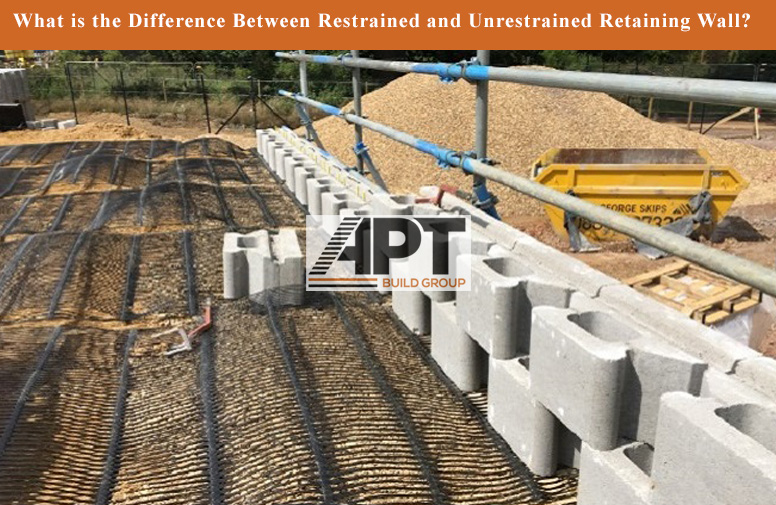
To fully understand What is the Difference Between Restrained and Unrestrained Retaining Wall?, it’s important to first define both types. A restrained retaining wall is a structure that is supported or held in position by external forces such as anchors, tiebacks, or structural connections to other elements. This additional restraint limits the wall’s movement when subjected to soil pressure. On the other hand, an unrestrained retaining wall relies primarily on its own weight and base width to resist the lateral pressure of soil. It is free to move slightly, which allows it to balance the forces acting upon it.
In practical terms, the restrained retaining wall is often used in areas where movement must be minimised, such as urban developments or near existing structures. Meanwhile, the unrestrained retaining wall is commonly used in open spaces where slight movement is acceptable and does not affect surrounding structures. Both systems are effective when designed correctly, but their applications differ significantly depending on site conditions and engineering requirements.
Structural Behaviour: What is the Difference Between Restrained and Unrestrained Retaining Wall?
When analysing What is the Difference Between Restrained and Unrestrained Retaining Wall?, one of the most important factors to consider is structural behaviour under load. A restrained retaining wall resists soil pressure through fixed supports or anchors, which significantly reduce its ability to move. Because of this, the wall experiences higher internal stresses, requiring careful engineering and reinforcement. The presence of anchors or tiebacks helps distribute the load deeper into the soil, improving overall stability in challenging conditions.
In contrast, an unrestrained retaining wall behaves differently because it is designed to allow controlled movement. This movement helps the wall reach a state of equilibrium where the forces acting on it are balanced. Rather than relying on external supports, the wall depends on its mass, geometry, and base friction to remain stable. This makes it a simpler and often more cost-effective solution in suitable environments.
At APTBuildGroup, we carefully assess soil type, slope angle, and surrounding structures before deciding whether a restrained retaining wall or an unrestrained retaining wall is the best option for a project.
Design and Construction Considerations
Another key aspect of What is the Difference Between Restrained and Unrestrained Retaining Wall? lies in their design and construction methods. A restrained retaining wall typically requires more complex engineering, including the installation of anchors, reinforcement systems, or connections to adjacent structures. These additional elements increase both the design time and construction cost, but they also provide higher levels of stability and safety in demanding conditions.
On the other hand, an unrestrained retaining wall is generally simpler to construct. It does not require anchors or tiebacks, which reduces labour and material costs. However, it must be designed with sufficient thickness and base width to ensure it can withstand soil pressure without external support. Proper drainage is also critical for both types of walls, as water pressure can significantly impact performance.
APTBuildGroup ensures that every retaining wall project is designed according to Australian standards, taking into account factors such as soil conditions, drainage requirements, and load-bearing capacity.
Applications in Real Projects: What is the Difference Between Restrained and Unrestrained Retaining Wall?
Exploring real-world applications helps clarify What is the Difference Between Restrained and Unrestrained Retaining Wall?. A restrained retaining wall is commonly used in situations where space is limited or where nearby structures must be protected from movement. Examples include basement walls, bridge abutments, and urban developments where stability is critical. These walls are ideal for handling high loads and steep slopes.
In contrast, an unrestrained retaining wall is often used in residential landscaping, garden terraces, and open areas where there is enough space for the wall to function without additional support. These walls are well-suited for moderate heights and less demanding conditions. Their simpler design makes them a popular choice for cost-effective projects.
At APTBuildGroup, we match the wall type to the specific needs of the site, ensuring optimal performance and longevity.
Advantages and Limitations
Understanding the advantages and limitations is crucial when discussing What is the Difference Between Restrained and Unrestrained Retaining Wall?. A restrained retaining wall offers superior stability and is capable of handling higher loads, making it suitable for complex and high-risk environments. However, it comes with higher costs and requires specialised construction techniques.
An unrestrained retaining wall, while more economical and easier to build, may not be suitable for all conditions. Its reliance on self-weight means it may require more space and may not perform well under very high loads or in confined areas. Choosing the wrong type can lead to structural issues, so careful planning is essential.
Choosing the Right Solution
Selecting between a restrained retaining wall and an unrestrained retaining wall depends on several factors, including site conditions, budget, and project requirements. Engineers must consider soil properties, drainage, wall height, and proximity to other structures before making a decision.
APTBuildGroup takes a comprehensive approach to every project, combining technical expertise with practical experience. We work closely with clients to determine the most suitable solution, ensuring that the chosen retaining wall system meets both functional and aesthetic requirements.
Conclusion: What is the Difference Between Restrained and Unrestrained Retaining Wall?
In conclusion, understanding What is the Difference Between Restrained and Unrestrained Retaining Wall? is key to making informed construction decisions. A restrained retaining wall provides enhanced stability through external supports, making it ideal for complex and high-load situations. An unrestrained retaining wall, on the other hand, relies on its own weight and design to maintain stability, offering a simpler and more cost-effective solution for less demanding applications.
Both types of retaining walls have their place in modern construction, and the choice between them should always be based on careful analysis and professional guidance. At APTBuildGroup, we are committed to delivering high-quality retaining wall solutions that are tailored to each project’s unique needs, ensuring safety, durability, and long-term performance.
Here are 10 FAQs for the topic “What is the Difference Between Restrained and Unrestrained Retaining Wall?” answered from the APTBuildGroup perspective:
What is a restrained retaining wall?
At APTBuildGroup, we define a restrained retaining wall as a structure that is supported by anchors, tiebacks, or other systems to limit movement and improve stability.
What is an unrestrained retaining wall?
APTBuildGroup explains an unrestrained retaining wall as a wall that relies on its own weight and base design to resist soil pressure without external support.
What is the main difference between restrained and unrestrained retaining walls?
According to APTBuildGroup, the key difference lies in support—restrained walls use external reinforcement, while unrestrained walls depend on their mass and design.
Which type of retaining wall is more stable?
APTBuildGroup recommends restrained retaining walls for higher stability, especially in areas with heavy loads or limited space.
Are unrestrained retaining walls cost-effective?
Yes, APTBuildGroup notes that unrestrained retaining walls are generally more affordable due to simpler design and construction processes.
Where are restrained retaining walls commonly used?
APTBuildGroup uses restrained retaining walls in projects such as basements, commercial sites, and areas with tight spaces or high structural demands.
Where are unrestrained retaining walls suitable?
APTBuildGroup often installs unrestrained retaining walls in residential landscaping and open areas where slight movement is acceptable.
Do both types require drainage systems?
APTBuildGroup strongly advises proper drainage for both restrained and unrestrained retaining walls to prevent water pressure build-up and damage.
How do I choose the right retaining wall for my project?
APTBuildGroup recommends assessing soil conditions, wall height, and site constraints, and consulting professionals for the best solution.
Why choose APTBuildGroup for retaining wall construction?
APTBuildGroup provides expert design, quality construction, and tailored solutions to ensure your retaining wall is safe, durable, and built to Australian standards.
Read more blogs:
What is the Difference Between Restrained and Unrestrained Retaining Wall | What Are the Failures of Cantilever Retaining Wall? | What Is a Concrete Plinth? | When Is an Anchored Retaining Wall Needed?