What Is a Cantilever Retaining Wall?
Introduction to Cantilever Retaining Walls
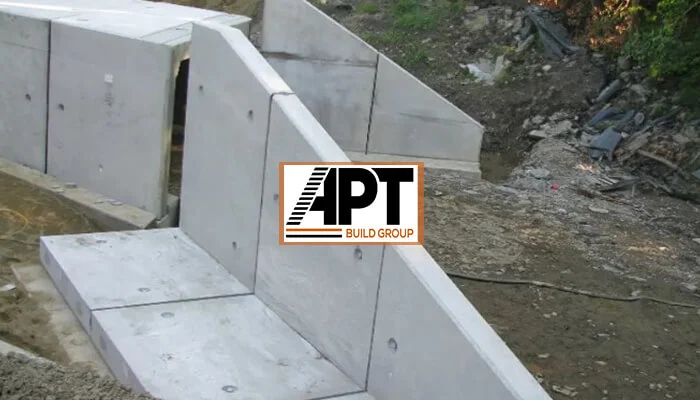
A cantilever retaining wall is one of the most commonly used retaining wall structures in civil engineering. It is designed to retain soil by utilizing reinforced concrete components that act together as a cantilever, efficiently resisting lateral earth pressure.
Definition of Cantilever Retaining Wall
A cantilever retaining wall is a reinforced concrete wall consisting of a thin vertical stem and a base slab. The base slab is divided into a heel and toe, which work together with reinforcement to provide stability against sliding, overturning, and bearing pressure.
Principle of Cantilever Retaining Walls
The wall works on the principle of cantilever action. The vertical stem acts as a cantilever fixed at the base, while the base slab counteracts earth pressure using its own weight and the weight of soil resting on the heel portion.
Main Components of a Cantilever Retaining Wall
The primary components include:
- Stem
- Base slab
- Heel slab
- Toe slab
- Reinforcement steel
- Backfill material
Each component plays a vital role in maintaining equilibrium and structural stability.
Materials Used in Cantilever Retaining Walls
Cantilever retaining walls are typically constructed using reinforced cement concrete (RCC) and high-strength steel reinforcement. Proper selection of materials enhances durability and load-carrying capacity.
Earth Pressure Considerations
Lateral earth pressure is a critical factor in cantilever wall design. Rankine’s or Coulomb’s earth pressure theory is commonly used to calculate the forces acting on the wall.
Design Considerations for Cantilever Retaining Walls
Key design factors include:
- Soil properties
- Bearing capacity of foundation soil
- Height of retained earth
- Surcharge loads
- Seismic forces
- Drainage conditions
These considerations ensure safety and efficiency.
Stability Analysis of Cantilever Retaining Walls
Stability checks are carried out against:
- Overturning
- Sliding
- Bearing capacity failure
Adequate factors of safety must be maintained in all cases.
Reinforcement Detailing
Proper reinforcement detailing in the stem, heel, and toe is essential to resist bending moments and shear forces. Correct anchorage and spacing ensure structural performance.
Drainage System Behind Cantilever Retaining Walls
Drainage provisions such as weep holes, drainage pipes, and filter media are provided to prevent hydrostatic pressure buildup behind the wall.
Construction Procedure
Construction involves excavation, foundation preparation, placement of reinforcement, formwork installation, concrete casting, curing, and controlled backfilling.
Applications of Cantilever Retaining Walls
Cantilever retaining walls are widely used in:
- Highway and railway embankments
- Basement walls
- Bridge abutments
- Industrial and commercial buildings
- Waterfront structures
Advantages of Cantilever Retaining Walls
Some major advantages include:
- Economical for heights up to 6–8 meters
- Requires less concrete compared to gravity walls
- Efficient use of reinforcement
- Suitable for limited space conditions
- Provides high structural stability
- Faster construction time
Limitations of Cantilever Retaining Walls
They require skilled design, precise reinforcement detailing, and good quality control. Poor drainage or weak foundation soil can reduce performance.
Conclusion
Cantilever retaining walls are an efficient and economical solution for retaining soil in modern construction. Their structural efficiency, adaptability, and durability make them a preferred choice for many engineering projects.
Frequently Asked Questions (FAQs)
1. What is the maximum height of a cantilever retaining wall?
Cantilever retaining walls are typically economical up to heights of about 6 to 8 meters.
2. Why is reinforcement required in cantilever retaining walls?
Reinforcement is necessary to resist bending moments and shear forces caused by lateral earth pressure.
3. What is the difference between gravity and cantilever retaining walls?
Gravity walls rely on mass, while cantilever walls rely on reinforced concrete action.
4. What type of soil is best for cantilever retaining walls?
Soils with good bearing capacity and proper drainage characteristics are most suitable.
5. Is drainage necessary behind cantilever retaining walls?
Yes, drainage is essential to prevent hydrostatic pressure buildup.
6. Can cantilever retaining walls be used in seismic zones?
Yes, with proper seismic design and reinforcement detailing.
7. What causes failure of cantilever retaining walls?
Common causes include poor drainage, inadequate design, and foundation settlement.
8. Are cantilever retaining walls cost-effective?
Yes, they are economical for medium-height retaining structures.
9. How long does a cantilever retaining wall last?
With proper design and maintenance, it can last 50 years or more.
10. Can cantilever retaining walls be used in residential construction?
Yes, they are commonly used for basement walls and retaining structures in residential projects.
Read more blogs:
Semi Gravity Retaining Wall
What Is a Cantilever Retaining Wall?
Design Guidance and Considerations for Retaining Wall Construction 2026
Choosing the Right Retaining Wall 2026