
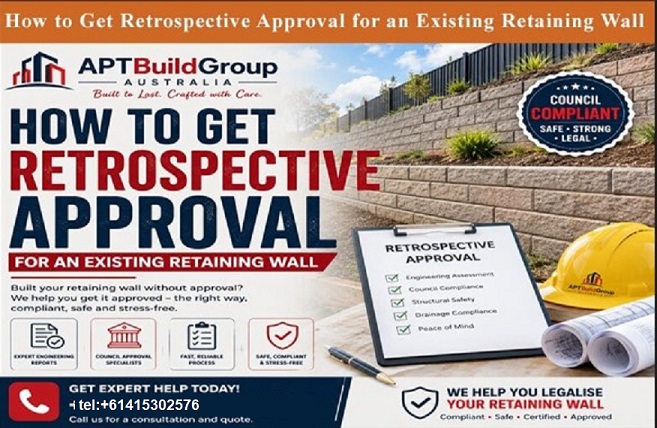
Retrospective Retaining Wall Approval
Many Australian homeowners only discover that their retaining wall required council approval after it has already been built. This situation commonly arises when purchasing a property, applying for renovations, selling a home, or following a complaint from a neighbour. (Retrospective Retaining Wall Approval)
Fortunately, constructing a retaining wall without prior approval does not always mean it must be demolished. In many situations, Australian councils allow homeowners to apply for retrospective approval, also known as a building approval after construction. The approval process ensures the retaining wall complies with local planning regulations, engineering standards, drainage requirements, and safety legislation.
Whether your retaining wall was built by a previous owner or installed without understanding local regulations, acting quickly is essential. Obtaining retrospective approval can prevent costly legal issues, council penalties, insurance complications, and delays during property sales.
This guide explains everything Australian property owners need to know about obtaining retrospective approval for an existing retaining wall, including documentation, inspections, engineering certificates, council requirements, common mistakes, and practical tips to maximise your chances of approval.
What Is Retrospective Approval?
Retrospective approval is the formal process of asking your local council or building authority to approve a retaining wall after it has already been constructed.
Instead of seeking permission before construction begins, the owner demonstrates that the completed retaining wall complies with applicable Australian standards, planning regulations, and engineering requirements.
Councils generally assess:
- Structural safety
- Height restrictions
- Drainage systems
- Boundary setbacks
- Soil stability
- Construction materials
- Environmental impacts
- Public safety
Approval is never automatic. Every application is assessed individually.
Why Retaining Walls Often Require Retrospective Approval
Several situations commonly lead to retrospective approval applications.
The Previous Owner Built the Wall
Many buyers inherit retaining walls that were constructed years ago without council approval or engineering documentation.
DIY Construction
Some homeowners build retaining walls themselves after watching online tutorials, unaware that permits may be required.
Contractor Failed to Obtain Approval
Occasionally a contractor completes the project without securing the necessary approvals, leaving the homeowner legally responsible.
Council Investigation
A complaint from a neighbour or council inspection may reveal an unapproved retaining wall.
Property Sale
Conveyancers frequently discover missing approvals during property transactions.
Can You Get Approval After a Retaining Wall Has Been Built?
Yes.
Across Australia, retrospective approval is generally possible if the retaining wall satisfies planning and structural requirements.
However, approval depends upon factors including:
- Overall structural condition
- Height of the wall
- Soil conditions
- Drainage performance
- Engineering design
- Proximity to neighbouring properties
- Local council regulations
If the wall does not comply, councils may require modifications before approval is granted.
In severe cases involving unsafe construction, complete replacement may be necessary.
Signs Your Existing Retaining Wall May Need Approval
Many homeowners are unsure whether their retaining wall required approval in the first place.
Common warning signs include:
The Wall Exceeds Local Height Limits
Higher retaining walls often require engineering certification and council approval.
No Engineering Drawings Exist
Missing structural documentation usually indicates approval may never have been obtained.
There Is No Building Permit
If no permit records can be found, retrospective approval may be necessary.
You Are Selling Your Property
Buyers frequently request evidence that retaining structures comply with council regulations.
Visible Structural Problems
Signs include:
- Leaning
- Bulging
- Cracking
- Poor drainage
- Soil movement
- Water pressure behind the wall
These issues often trigger further council assessment.
Step-by-Step Process for Getting Retrospective Approval

Step 1 – Contact Your Local Council
Every Australian council has different planning rules.
Start by asking:
- Was approval originally required?
- Is retrospective approval available?
- Which documents are needed?
- What fees apply?
Obtaining accurate advice early saves considerable time.
Step 2 – Arrange a Site Inspection
A qualified building surveyor or engineer usually inspects:
- Structural integrity
- Materials used
- Foundations
- Drainage
- Reinforcement
- Dimensions
- Safety risks
The inspection identifies whether the wall complies or requires upgrades.
Step 3 – Hire a Structural Engineer
An engineer prepares technical documentation confirming whether the retaining wall satisfies Australian engineering standards.
The report may include:
Structural Assessment
Calculations confirm the wall safely resists soil pressure.
Footing Inspection
The engineer evaluates whether foundations are adequate.
Drainage Review
Drainage is critical because water pressure causes many retaining wall failures.
Safety Recommendations
If problems exist, the engineer specifies required improvements.
Step 4 – Prepare Supporting Documents
Most councils request several supporting documents.
Typical requirements include:
Site Plan
Showing:
- Property boundaries
- Wall location
- Adjacent structures
- Easements
Engineering Report
Prepared by a qualified engineer.
Survey Plans
If boundary issues exist.
Photographs
Current images showing every side of the retaining wall.
Construction Details
Where available:
- Materials
- Builder details
- Construction date
- Dimensions
Engineering Certification for Existing Retaining Walls
Engineering certification is often the most important part of retrospective approval.
The engineer assesses whether the wall complies with:
- Australian Standards
- Local building codes
- Soil conditions
- Load requirements
- Drainage performance
The certification provides councils with confidence that the retaining wall does not present a public safety risk.
If deficiencies are identified, certification may be conditional upon repairs.
Common Reasons Councils Reject Applications
Retrospective approval is not guaranteed.
Applications are commonly refused due to:
Poor Drainage
Water pressure behind the retaining wall significantly increases structural loads.
Insufficient Footings
Shallow foundations reduce stability.
Excessive Wall Height
Walls exceeding local limits without engineering design may not comply.
Incorrect Construction Materials
Low-quality materials often fail to meet structural standards.
Boundary Encroachment
Walls extending onto neighbouring land can create legal complications.
Structural Movement
Visible leaning or cracking usually requires engineering remediation before approval.
How Much Does Retrospective Approval Cost?
Costs vary depending on:
- Council application fees
- Engineering reports
- Survey plans
- Building inspections
- Soil testing
- Repairs required
Homeowners should budget for both approval costs and any modifications required to achieve compliance.
While obtaining retrospective approval involves expense, it is generally more affordable than dealing with enforcement action or rebuilding an unsafe retaining wall.
How Long Does Retrospective Approval Take?
The timeframe for obtaining retrospective approval varies across Australia depending on the local council, the complexity of the retaining wall, and whether additional information is required. A straightforward application with complete documentation may be processed within a few weeks, while more complex cases involving engineering reports, surveys, or modifications can take several months.
Factors that influence approval time include:
Completeness of Your Application
Submitting all required documents, plans, and reports from the beginning helps avoid unnecessary delays.
Council Workload
Approval times often depend on the number of applications currently being assessed by your local council.
Engineering Assessments
If the council requests further engineering calculations or inspections, additional time will be required.
Required Modifications
Where the retaining wall does not initially comply, approval may only be granted after repairs or upgrades have been completed and re-inspected.
Although the process requires patience, responding quickly to council requests can significantly reduce delays.
What Happens If Retrospective Approval Is Refused?
Not every retaining wall can be approved in its existing condition. If your application is refused, the council will usually explain why and outline the steps required to achieve compliance.
Possible outcomes include:
Structural Repairs
You may be required to strengthen the retaining wall by improving its foundations, reinforcement, drainage, or backfill.
Partial Reconstruction
If only part of the retaining wall fails to meet requirements, modifications may be sufficient rather than complete replacement.
Complete Replacement
Where the retaining wall presents a serious structural or safety risk, the council may require demolition and reconstruction in accordance with current regulations.
Further Engineering Design
Additional engineering calculations or revised construction drawings may allow a previously rejected application to be approved.
Receiving a refusal does not necessarily mean the project has failed. In many cases, compliance can be achieved through practical improvements.
Retaining Walls Built by Previous Owners
One of the most common situations occurs when homeowners purchase a property only to discover that an existing retaining wall was never approved.
Unfortunately, responsibility for resolving the issue generally rests with the current property owner, regardless of who originally built the wall.
If you discover an unapproved retaining wall after purchasing a home:
Request Council Records
Confirm whether any permits or approvals were ever issued.
Obtain an Engineering Inspection
An engineer can assess whether the retaining wall complies with Australian Standards.
Keep All Documentation
Store inspection reports, engineering certificates, invoices, and council correspondence for future property transactions.
Taking action early can prevent complications when refinancing, renovating, or selling your property.
Can You Sell a Property with an Unapproved Retaining Wall?
Yes, but an unapproved retaining wall can create challenges during the sale process.
Potential buyers often conduct building and pest inspections, while conveyancers may search council records to verify approvals. If documentation is missing, buyers may:
- Request retrospective approval before settlement.
- Negotiate a lower purchase price.
- Ask the seller to complete repairs.
- Withdraw from the purchase if significant safety concerns exist.
Obtaining retrospective approval before listing your property demonstrates transparency and can increase buyer confidence.
Insurance Implications of an Unapproved Retaining Wall
Many homeowners overlook the insurance risks associated with unapproved structures.
If an unapproved retaining wall fails and causes damage to neighbouring properties, vehicles, or buildings, your insurer may investigate whether the wall complied with relevant regulations.
While insurance outcomes depend on the policy and circumstances, having engineering certification and council approval provides stronger evidence that the retaining wall was constructed responsibly.
It is advisable to notify your insurer once retrospective approval has been granted and retain copies of all supporting documents.
Common Mistakes to Avoid
Obtaining retrospective approval becomes much easier when homeowners avoid common errors.
Ignoring Council Notices
Failing to respond to compliance notices can result in enforcement action and additional costs.
Assuming Older Walls Are Automatically Approved
Age does not guarantee compliance. Even retaining walls built decades ago may still require assessment.
Delaying Repairs
Small defects such as blocked drainage, minor cracks, or soil erosion can develop into significant structural problems if left untreated.
Hiring Unqualified Contractors
Repairs should be completed by experienced professionals who understand Australian retaining wall standards and local council requirements.
Failing to Maintain Records
Keep copies of:
- Engineering certificates
- Council approvals
- Inspection reports
- Invoices
- Photographs
- Construction drawings
These documents may be required years later during property sales or renovations.
Tips for a Successful Retrospective Approval Application
The following practical steps can improve your chances of approval:
Speak with Your Local Council Early
Understanding local requirements before lodging an application helps prevent unnecessary delays.
Use a Qualified Structural Engineer
Professional engineering reports carry significant weight during the assessment process.
Fix Obvious Defects Before Applying
Repairing drainage issues, damaged sections, or visible structural defects demonstrates a commitment to compliance.
Submit Complete Documentation
Applications containing accurate plans, reports, photographs, and supporting information are generally processed more efficiently.
Be Honest About the Wall’s History
Providing accurate information helps establish trust and avoids complications later in the process.
Council Compliance Checklist
Before submitting your retrospective approval application, ensure you have completed the following:
- Confirm whether council approval is required.
- Obtain a structural engineering inspection.
- Prepare a detailed site plan.
- Collect recent photographs of the retaining wall.
- Arrange a land survey if boundary locations are uncertain.
- Address any visible structural defects.
- Improve drainage where necessary.
- Complete all required council application forms.
- Pay applicable assessment fees.
- Keep copies of every document submitted.
Conclusion
Retrospective approval for an existing retaining wall is an important process that protects homeowners, neighbours, and the wider community by ensuring retaining structures are safe and compliant with Australian regulations. While discovering that a retaining wall lacks approval can be stressful, it does not automatically mean the structure must be removed.
By consulting your local council, engaging a qualified structural engineer, preparing complete documentation, and addressing any identified issues, you can greatly improve your chances of obtaining approval. Acting promptly not only helps avoid enforcement action and costly legal disputes but also provides peace of mind when insuring, renovating, or selling your property.
A compliant, well-maintained retaining wall is a valuable long-term investment, contributing to the safety, stability, and value of your property for years to come.
Frequently Asked Questions
1. What is retrospective approval for a retaining wall?
It is council approval obtained after a retaining wall has already been built.
2. Can I legalise an existing retaining wall?
In many cases, yes, provided the retaining wall meets local planning and engineering requirements.
3. Is an engineer required for retrospective approval?
Many councils require an engineering inspection and certification, particularly for larger or more complex retaining walls.
4. Can I apply if I did not build the retaining wall?
Yes. The current property owner can apply, even if a previous owner constructed the wall.
5. Will council inspect my retaining wall?
Most applications involve either a council inspection, a private building surveyor’s inspection, or both.
6. What documents are normally required?
Site plans, engineering reports, photographs, surveys (where applicable), and council application forms.
7. Can approval be refused?
Yes. Unsafe or non-compliant retaining walls may require repairs or replacement before approval is granted.
8. How much does retrospective approval cost?
Costs vary depending on council fees, engineering reports, surveys, inspections, and any required repairs.
9. Can I sell my house without approval?
Yes, but missing approvals can delay settlement or reduce buyer confidence.
10. Will insurance cover an unapproved retaining wall?
Coverage depends on the policy and circumstances. Approval and certification generally provide greater certainty.
11. What if my retaining wall is leaning?
A structural engineer should assess the wall immediately, as movement may indicate underlying failure.
12. Does every retaining wall require approval?
No. Requirements vary depending on wall height, location, and local council regulations.
13. Can drainage issues affect approval?
Yes. Proper drainage is a key factor in structural performance and council assessments.
14. How long should a retaining wall last?
A well-designed retaining wall can last several decades with proper construction and maintenance.
15. What is the biggest reason applications are rejected?
Poor structural integrity, inadequate drainage, and failure to meet local building requirements are among the most common reasons.
Read more
What Happens If You Build a Retaining Wall Without Council Approval? | Retaining Wall Regulations: Gold Coast vs Brisbane vs Ipswich | Retaining Wall Height Limits Part 1 | Retaining Wall Height Limits Part 2