Cantilever Retaining Walls Explained 2026
Cantilever Retaining Walls Explained 2026 – Introduction
The construction industry continues to evolve with stronger engineering practices, smarter materials, and improved design standards. In this Cantilever Retaining Walls Explained 2026 guide, we explore one of the most reliable and widely used retaining wall systems in modern construction. Whether for residential developments, commercial projects, or sloped landscapes, cantilever retaining walls provide excellent structural performance when designed correctly.
At APTBuildGroup Brisbane QLD Australia, we specialise in retaining wall construction that meets both engineering requirements and aesthetic expectations. Our experience across Brisbane and Queensland allows us to deliver retaining wall solutions suited to local soil conditions, environmental factors, and council compliance standards.
Cantilever Retaining Walls Explained 2026 – What Is a Cantilever Retaining Wall?
To understand Cantilever Retaining Walls Explained 2026, it is important to first know what a cantilever retaining wall actually is. A cantilever retaining wall is a reinforced concrete wall designed to retain soil by using leverage and structural resistance rather than relying purely on weight.
Unlike gravity walls, which depend on their mass to resist soil pressure, cantilever walls use a reinforced base slab and vertical wall stem to transfer loads into the foundation.
The structure generally consists of:
- A vertical reinforced concrete stem
- A base slab
- A heel section beneath the retained soil
- A toe section extending outward
- Steel reinforcement for structural stability
At APTBuildGroup Brisbane QLD Australia, cantilever retaining walls are commonly used for projects where higher wall heights or limited space require engineered support.
Cantilever Retaining Walls Explained 2026 – How Cantilever Walls Work
A major focus of Cantilever Retaining Walls Explained 2026 is understanding how these walls perform structurally.
Cantilever retaining walls work by balancing forces. The retained soil pushes horizontally against the wall, creating lateral pressure. The wall resists this pressure through:
- The weight of the soil resting above the heel section
- The reinforced concrete base slab
- Structural leverage created by the cantilever action
The design allows the wall to transfer pressure safely into the ground beneath the footing.
At APTBuildGroup Brisbane QLD Australia, engineering calculations are carefully performed to ensure the wall can resist sliding, overturning, and bearing pressure.
Cantilever Retaining Walls Explained 2026 – Common Applications
The Cantilever Retaining Walls Explained 2026 guide highlights the wide range of applications where cantilever walls are commonly used.
Residential Developments
Cantilever retaining walls are ideal for creating level outdoor areas, supporting sloped yards, and improving landscape usability.
Commercial Construction
Commercial projects often require engineered retaining walls to support parking areas, buildings, and access roads.
Infrastructure Projects
Roadways, bridge approaches, and public infrastructure frequently rely on cantilever retaining wall systems.
Limited Space Sites
Cantilever walls are ideal for narrow properties where wider gravity walls may not fit.
At APTBuildGroup Brisbane QLD Australia, we customise retaining wall designs to suit each specific project type.
Cantilever Retaining Walls Explained 2026 – Benefits of Cantilever Retaining Walls
One of the most important sections of Cantilever Retaining Walls Explained 2026 is understanding the benefits.
High Structural Strength
Cantilever walls are designed to resist heavy soil loads and surcharge pressures.
Space Efficiency
Compared to gravity walls, cantilever walls require less material thickness and occupy less space.
Cost Efficiency for Larger Walls
Although engineering costs may be higher, cantilever walls can become more economical for taller structures.
Long Lifespan
Properly constructed reinforced concrete retaining walls can last for decades.
Modern Design Flexibility
Cantilever retaining walls can be integrated into modern landscape and architectural designs.
APTBuildGroup Brisbane QLD Australia uses advanced construction techniques to maximise these advantages.
Cantilever Retaining Walls Explained 2026 – Design Considerations
Proper design is a critical element of Cantilever Retaining Walls Explained 2026.
Several factors influence the design process:
Soil Conditions
Soil type directly affects wall stability and bearing capacity.
Wall Height
Taller walls require more reinforcement and stronger footing systems.
Drainage Requirements
Water pressure behind the wall must be controlled.
Surcharge Loads
Loads such as vehicles, buildings, or heavy landscaping affect wall design.
Engineering Standards
Compliance with Australian regulations is essential.
At APTBuildGroup Brisbane QLD Australia, every retaining wall project begins with a site assessment and engineering review.
Cantilever Retaining Walls Explained 2026 – Drainage Importance
No Cantilever Retaining Walls Explained 2026 guide would be complete without discussing drainage.
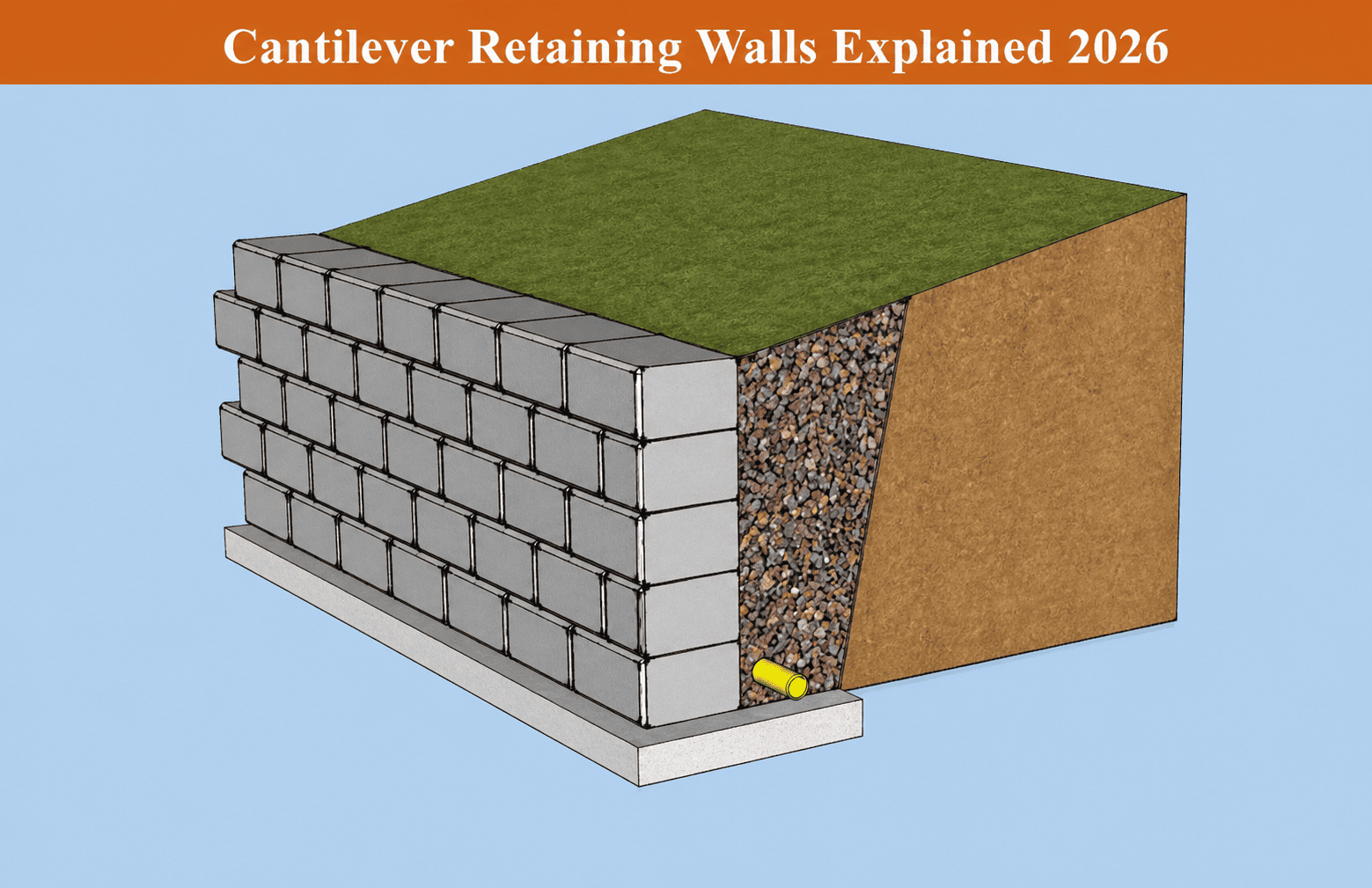
Poor drainage is one of the most common reasons retaining walls fail. Water buildup behind the wall creates hydrostatic pressure, increasing stress on the structure.
Effective drainage systems include:
- Gravel backfill
- Drainage pipes
- Weep holes
- Geotextile membranes
At APTBuildGroup Brisbane QLD Australia, drainage systems are incorporated into every retaining wall installation to protect long-term structural performance.
Cantilever Retaining Walls Explained 2026 – Construction Process
The Cantilever Retaining Walls Explained 2026 article also highlights the importance of professional construction.
Step 1: Excavation
The site is excavated according to engineering specifications.
Step 2: Base Preparation
A strong compacted base is created.
Step 3: Reinforcement Placement
Steel reinforcement is installed based on engineering drawings.
Step 4: Formwork and Concrete Pouring
Concrete is poured into formwork to create the wall stem and base slab.
Step 5: Drainage Installation
Drainage systems are installed behind the wall.
Step 6: Backfilling
The area behind the wall is carefully compacted.
APTBuildGroup Brisbane QLD Australia ensures every construction stage is completed with precision.
Cantilever Retaining Walls Explained 2026 – Maintenance Tips
Maintenance is another important topic in Cantilever Retaining Walls Explained 2026.
While cantilever retaining walls are low maintenance, regular inspections are recommended.
Maintenance Tips:
- Check for visible cracks
- Monitor drainage performance
- Inspect for settlement or movement
- Keep drainage outlets clear
Routine maintenance can significantly extend the lifespan of the wall.
Cantilever Retaining Walls Explained 2026 – Why Choose APTBuildGroup Brisbane QLD Australia
Choosing the right contractor is essential in the Cantilever Retaining Walls Explained 2026 process.
At APTBuildGroup Brisbane QLD Australia, we offer:
- Professional retaining wall design
- Engineering-compliant construction
- Premium-quality materials
- Experienced installation teams
- Custom retaining wall solutions
Our goal is to build retaining walls that provide structural reliability while enhancing the appearance of your property.
Cantilever Retaining Walls Explained 2026 – Conclusion
This Cantilever Retaining Walls Explained 2026 guide demonstrates why cantilever retaining walls remain one of the most effective retaining systems available today.
Their structural efficiency, space-saving design, and long-term durability make them ideal for many residential and commercial applications.
With expert construction services from APTBuildGroup Brisbane QLD Australia, you can ensure your retaining wall project is completed to the highest engineering and construction standards.
Whether you are developing a sloped property, improving landscape functionality, or managing a large-scale project, APTBuildGroup Brisbane QLD Australia provides reliable retaining wall solutions tailored to your needs.
FAQs – Cantilever Retaining Walls Explained 2026
What is a cantilever retaining wall?
A cantilever retaining wall is a reinforced concrete structure designed to hold back soil using leverage and structural support rather than relying only on weight. At APTBuildGroup Brisbane QLD, we commonly use cantilever walls for projects that require strong and space-efficient retaining solutions.
Where are cantilever retaining walls commonly used?
Cantilever retaining walls are widely used in residential landscaping, commercial developments, sloped properties, driveways, and infrastructure projects. APTBuildGroup Brisbane QLD installs cantilever walls across Brisbane for both small and large-scale projects.
What makes cantilever retaining walls different from gravity walls?
Cantilever walls use reinforced concrete and engineering design to resist soil pressure, while gravity walls depend on their own mass for stability. Cantilever walls are often more suitable for taller walls and limited-space areas.
Are cantilever retaining walls suitable for Brisbane soil conditions?
Yes, cantilever retaining walls can perform very well in Brisbane conditions when designed correctly. APTBuildGroup Brisbane QLD assesses soil type, drainage, and site slope before recommending the best retaining wall solution.
How long do cantilever retaining walls last?
A properly designed and installed cantilever retaining wall can last 50 years or more. At APTBuildGroup Brisbane QLD, we focus on quality construction and drainage systems to maximise durability.
Do cantilever retaining walls require drainage?
Yes, drainage is essential. Without proper drainage, water pressure can build up behind the wall and cause structural damage. APTBuildGroup Brisbane QLD includes drainage systems in every retaining wall installation.
Are cantilever retaining walls expensive?
Cantilever retaining walls may have a higher upfront cost due to engineering and reinforced concrete requirements. However, they are often cost-effective for larger or taller retaining walls because of their structural efficiency.
Can cantilever retaining walls be customised?
Yes, cantilever retaining walls can be customised to suit different heights, finishes, and site conditions. APTBuildGroup Brisbane QLD provides tailored retaining wall solutions based on each client’s project needs.
Do cantilever retaining walls need council approval in Brisbane?
In many cases, retaining walls above certain heights require engineering approval and council compliance. APTBuildGroup Brisbane QLD assists clients with approvals and ensures all work meets Queensland regulations.
Why choose APTBuildGroup Brisbane QLD for cantilever retaining walls?
APTBuildGroup Brisbane QLD provides expert retaining wall design, engineering support, quality materials, and professional installation. Our team delivers durable, compliant, and visually appealing retaining wall solutions across Brisbane and surrounding areas.
Read more blog for the month of April 2026
Retaining Wall Designs Guide 2026 | Gravity vs Cantilever Retaining Walls 2026
Cantilever Retaining Walls Explained 2026 | Gravity Retaining Walls Explained 2026 | Semi Gravity Retaining Walls 2026 | Modern Colorbond Fencing Ideas 2026