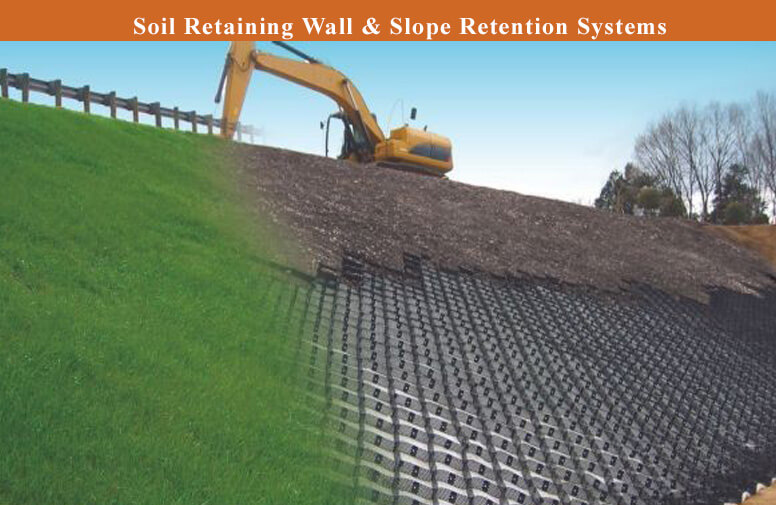
Soil Retaining Walls & Slope Retention Systems: A Smart Business Investment for Brisbane Properties
Why Slope Management Is a Strategic Business Decision
Brisbane’s dramatic topography — its rolling hills, steep residential lots, and flood-prone lowlands — means that soil movement is not merely a cosmetic issue. It is a structural, financial, and legal liability. For commercial developers, homebuilders, and civil contractors operating across Greater Brisbane, investing in engineered retaining walls and slope retention systems is one of the highest-return decisions a project team can make.
At APTbuildGroup, we have seen first-hand how inadequate slope management erodes land value, inflates insurance premiums, and triggers costly remediation works years after practical completion. Conversely, projects that budget proactively for soil retention protect asset value, satisfy council requirements, and reduce long-term maintenance obligations.
The Hidden Cost of Doing Nothing
Unmanaged slopes fail gradually — and then suddenly. Soil creep, surface erosion, and saturation-driven slippage do not announce themselves until the damage is already expensive. In South East Queensland’s subtropical climate, where summer rainfall events regularly exceed 100mm in 24 hours, the engineering forces acting on a poorly managed embankment are substantial.
From a business perspective, the cost of soil failure typically includes:
- Emergency stabilisation works billed at crisis-response rates
- Council enforcement notices that halt construction on affected lots
- Insurance complications when earthworks have not been certified to Queensland Development Code (QDC) standards
- Reduced resale value on properties with visible erosion or unstable batters
The business case for pre-emptive retention investment is clear: structured upfront costs significantly outweigh reactive remediation expenditure.
Soil Retaining Walls & Slope Retention Systems in 2026 – topical mapping
Topical Mapping: Key Systems and Where They Belong
Understanding which retention system suits which site condition is core to cost-efficient specification. Below is a practical framework that APTbuildGroup applies across residential, commercial, and civil projects in Brisbane and the surrounding regions.
1. Gravity Retaining Walls — Mass-Dependent Stability
Gravity walls rely on their own weight to resist lateral earth pressure. Constructed from concrete blocks, natural stone, or precast concrete panels, they are best suited to low-to-medium height applications (typically up to 1.5 metres without engineer certification). On level-change landscaping projects and residential boundary retaining in Suburbs such as Kenmore, Fig Tree Pocket, and Chapel Hill, gravity systems offer a cost-effective, low-maintenance solution.
Business insight: Gravity walls have a lower upfront cost but consume more material volume. They are most profitable when local aggregate or block pricing is competitive and when footprint space is available for the wall’s wider base.
2. Cantilever Retaining Walls — Engineer-Certified Structural Performance
For retained heights above 1.5 metres, Queensland regulations require engineering certification. Cantilever walls — typically reinforced concrete with a footing that extends behind the wall face — are the structural workhorse of Brisbane’s sloped development sites. From hillside subdivisions in The Gap to commercial earthworks in Yatala, cantilever systems provide certified structural performance with a slim profile that conserves lot footprint.
Business insight: While design and certification costs add 15–25% to the project spend compared to gravity walls, the regulatory compliance protects developers from stop-work orders and enables greater site yield by retaining steeper batters more efficiently.
3. Gabion and Rock Basket Walls — Ecological and Aesthetic Value
Gabion walls — wire mesh baskets filled with locally sourced rock — are experiencing renewed demand in Brisbane’s green-development sector. They are permeable by nature, which reduces hydrostatic pressure build-up and eliminates the need for costly drainage infrastructure behind the wall. They also integrate well with natural revegetation strategies, which aligns with council biodiversity overlays increasingly applied to hillside and riparian sites across Brisbane City Council and Moreton Bay Regional Council jurisdictions.
Business insight: Gabion systems command a design premium and a stronger sustainability narrative, making them particularly suited to boutique residential projects, eco-resort developments, and council-funded erosion control works where green credentials form part of the contract tender criteria.
4. Geosynthetic Reinforced Earth (GRE) Systems — Large-Scale Slope Engineering
For major earthworks — road batters, large fill embankments, and commercial site preparation — Geosynthetic Reinforced Earth offers the most cost-effective solution per cubic metre of retained soil. By embedding geogrid or geotextile layers within compacted fill, GRE systems distribute load across a wide failure plane, dramatically reducing the risk of deep-seated slope failure.
Business insight: GRE is especially relevant in South East Queensland’s infrastructure-growth corridor from Brisbane to the Sunshine Coast. As council and state government investment in transport and community infrastructure accelerates ahead of the 2032 Olympic Games, contractors with GRE competency are well positioned for civil earthworks tender opportunities.
5. Vegetation-Based Bioengineering — Living Retention Systems
Bioengineering — using deep-rooted native species, coir logs, and fascine bundles to stabilise slopes — is not simply an environmental gesture. It is a cost-effective retention strategy for low-angle slopes, creek banks, and rehabilitation zones. Root systems from species such as Lomandra longifolia, Ficinia nodosa, and native sedges bind the top 600mm of soil, which is precisely the zone most vulnerable to rainfall erosion.
Business insight: Bioengineering solutions attract favourable consideration under Brisbane’s Natural Assets Local Law and can reduce offset obligations for vegetation clearing. Where it is specification-appropriate, recommending bioengineering components adds genuine value and differentiates a contractor’s scope in tender submissions.
Compliance, Council, and Certification in Brisbane
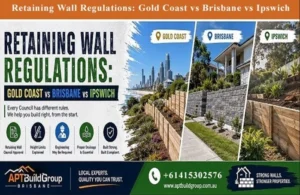
All retaining walls in Queensland exceeding 1 metre in retained height (measured at the base) require a building approval under the Building Act 1975. Walls adjacent to property boundaries, drainage easements, or utilities trigger additional assessment pathways. APTbuildGroup manages the full compliance lifecycle — from geotechnical investigation and hydraulic assessment through to final certification — reducing the administrative burden on developers and property owners.
Working proactively with Brisbane City Council’s development officers and engaging registered engineers early in the design phase consistently shortens approval timeframes and reduces the risk of design amendments post-lodgement.
The APTbuildGroup Advantage
Our Brisbane-based team brings civil construction expertise, geotechnical insight, and commercial acumen to every slope retention project. We understand that a retaining wall is not just an engineering solution — it is a component of a broader project economics model. Our approach integrates design, compliance, construction, and cost control from the initial site assessment through to handover.
Whether the project is a residential level-change in Pullenvale, a commercial earthworks package in Darra, or a large-scale subdivision across the Moreton Bay growth corridor, APTbuildGroup delivers retention systems that protect land, protect investment, and meet every Queensland regulatory requirement.
Contact APTbuildGroup today to schedule a site assessment and retaining wall feasibility consultation for your Brisbane project.
Read more blogs:
Soil Retaining Walls & Slope Retention Systems in 2026 | Gravity vs Cantilever Retaining Walls 2026
Cantilever Retaining Walls Explained 2026 | Gravity Retaining Walls Explained 2026 | Semi Gravity Retaining Walls 2026 | Modern Colorbond Fencing Ideas 2026